

Charged For Flying A Drone In Texas? What To Do Next
Key Takeaways:
Drone charges in Texas can come from state law, federal law, or both, and the FAA can add civil fines. State offenses for flying over stadiums, critical infrastructure, airports, or jails are usually Class B misdemeanors. Federal restricted-airspace charges can carry one to three years in prison. Stay silent, keep your flight records, and get legal advice before talking to police, the FBI, or the FAA.
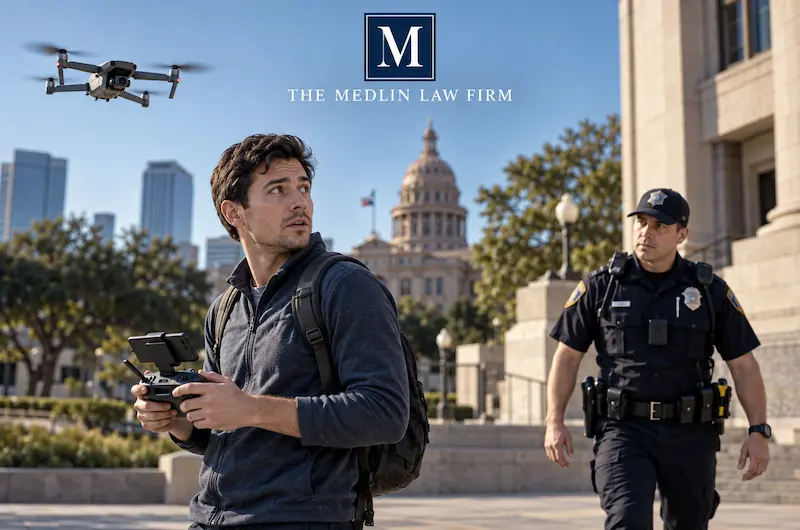
A drone case can start with a knock on the door, a seized controller outside a stadium, or a citation weeks after a flight. The first thing you need to know is which government is bringing the case, because that decides the court, the punishment range, and the pace.
Drone Charges In Texas: Find Out Which Case You Are Facing
One flight can trigger three separate tracks, and they can run at the same time.
| Track | Who Brings It | Common Legal Basis | Possible Penalty |
| Texas criminal charge | City, county, or district attorney | Tex. Gov’t Code Ch. 423; Tex. Penal Code §§ 38.115, 42.15 | From a $500 fine to 2 years in state jail |
| Federal criminal charge | U.S. Attorney’s Office | 49 U.S.C. §§ 46306, 46307; 18 U.S.C. § 39B | 1 to 3 years maximum for common airspace counts |
| FAA civil enforcement | Federal Aviation Administration | Part 107, recreational rules, registration | Up to $75,000 per violation, certificate action |
An FAA civil penalty is not a criminal conviction, but statements you give FAA investigators can still reach prosecutors.
What To Do Right After A Drone Citation Or Arrest
- Stop explaining. Provide identification when required, then ask to speak with a lawyer. Officers record what you say about altitude and location.
- Read the paperwork. A Class C citation, a county court complaint, and a federal complaint carry different courts and deadlines.
- Keep every court date, because a missed setting can lead to a warrant.
- Leave your app data alone. Deleting flights or footage can look like destroying evidence and erasing records that help you.
- Get the charge reviewed before paying anything. Paying a Texas citation usually means a plea that ends in a conviction.
Texas Drone Offenses & Penalties
In Texas, location usually decides the charge. Several offenses also require proof that you flew at or below 400 feet over the protected site.
| Conduct | Statute | Offense Level | Maximum Punishment |
| Capturing images with intent to conduct surveillance | Gov’t Code § 423.003 | Class C | $500 fine |
| Sharing or using an unlawfully captured image | Gov’t Code § 423.004 | Class B | 180 days in jail, $2,000 fine |
| Flying over a sports venue or critical infrastructure facility | Gov’t Code §§ 423.0045, 423.0046 | Class B; Class A with a prior | 180 days to 1 year in jail |
| Flying over an airport, military installation, or spaceport | Penal Code § 42.15 | Class B; Class A with a prior | 180 days to 1 year in jail |
| Flying over a jail or prison | Penal Code § 38.115 | Class B; state jail felony with contraband | Up to 2 years in state jail |
Under Texas Penal Code § 38.115, using a drone to deliver contraband into a jail or prison makes the case a felony. Despite older claims online, Chapter 423 remains enforceable after the Fifth Circuit’s 2024 ruling.
Federal Drone Charges After Stadium & Airport Flights
During the 2026 World Cup, federal authorities seized 94 drones in North Texas and charged three operators, while most other encounters ended in administrative enforcement. One Arlington case was filed as a federal complaint for operating as an airman without a certificate, which carries up to three years in federal prison.
Other stadium cases rely on the national defense airspace statute, which carries up to one year in prison and a fine up to $100,000. Flights into the runway exclusion zone at DFW or Love Field can add charges under 18 U.S.C. § 39B.
Federal cases move fast. If you are not a U.S. citizen, a federal conviction can also affect your immigration status.
What Prosecutors Must Prove & Where Defenses Start
The government carries the burden of proof. In a restricted-airspace case, it usually must prove three things:
- you were the pilot;
- the drone was inside the restricted area during the restricted time;
- you lacked authorization.
Federal airspace counts often require proof that you acted knowingly or willfully.
Defenses start with the details. The flight may have stayed outside the radius or ended before the restriction began. Detection equipment can misplace a drone or link it to the wrong controller. A waiver or written consent may cover the flight, and Chapter 423 lists 21 lawful uses. Destroying an image promptly, without sharing it, is also a defense to a surveillance charge.
Evidence To Preserve Before It Disappears
- Flight logs from the DJI Fly app, your DJI account, or the controller
- Photos and video saved on the drone, phone, or cloud account
- FAA registration and Remote ID records
- Part 107 or TRUST certificates, waivers, LAANC approvals, and airspace app screenshots
- The citation or complaint and the property receipt for a seized drone
Your lawyer can also request the government’s detection logs.
Can A Drone Charge Stay Off Your Record?
A state or federal drone conviction becomes part of your criminal history and can appear on background checks. A dismissal or acquittal can make you eligible for expunction under Texas Code of Criminal Procedure Chapter 55A. Completing deferred adjudication on a Class B charge may allow an order of nondisclosure. Federal convictions offer fewer clearing options, so ask about record consequences before any plea.
Frequently Asked Questions About Drone Charges In Texas
Get A Confidential Drone Case Evaluation From The Medlin Law Firm
A drone case can move from a seized controller to a criminal complaint quickly. Gary Medlin, a former prosecutor, is Board Certified in Criminal Law by the Texas Board of Legal Specialization. We review the charge, the flight evidence, and what the government can actually prove before you make any decision, with flat fees so you know the cost up front. Schedule a confidential case evaluation with The Medlin Law Firm to understand the charge, the punishment range, and your next steps.
Related Posts



Request a Free Case Evaluation
CATEGORIES