

Drone Charges At Texas Stadiums & Major Sporting Events
Summary:
Drone charges at Texas stadiums can come from federal law, state law, or both. A standing FAA restriction bars drones within 3 nautical miles and below 3,000 feet of large stadiums during NFL, MLB, NCAA Division I football, and major motor speedway events. Federal airspace charges carry up to one to three years in prison, and Texas adds a Class B misdemeanor for flying over sports venues. Stay silent, preserve your flight logs, and get legal advice before answering questions.
A few minutes of game-day footage can lead to a seized drone, an FBI interview, and a federal complaint. Stadium flights draw more enforcement than almost any other drone activity in Texas, and the case often starts before you leave the parking lot.
What Happens If You Fly A Drone Over A Texas Stadium?
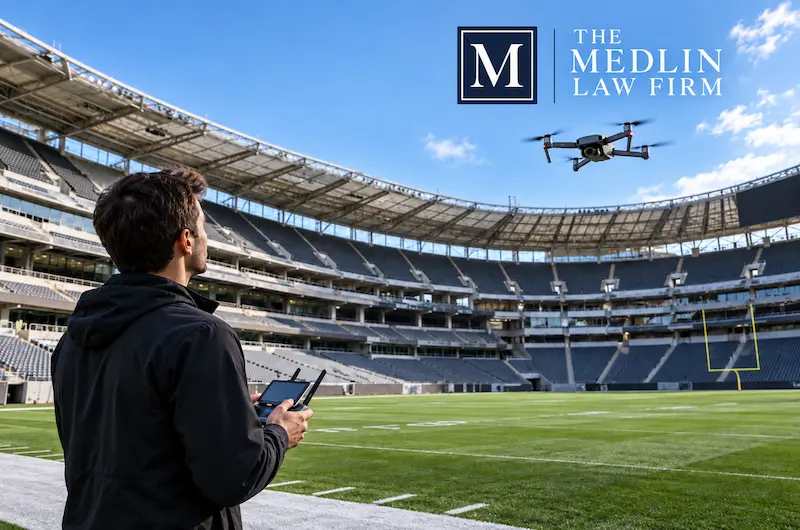
Agents can detect the drone, locate you, and seize the aircraft and controller on the spot. From there, the case can go three ways: an FAA civil penalty, a Texas misdemeanor, or a federal criminal charge, the same split seen in airport crime cases at DFW & Love Field . Prosecutors decide case by case, and the same flight can produce more than one case.
During the 2026 World Cup, federal authorities seized 94 drones in North Texas and charged three operators, while most other encounters ended in administrative enforcement. In Houston, four residents were charged with violating national defense airspace near the fan festival. Nationwide, the FBI reported more than 700 drones seized at World Cup venues.
The Stadium No-Fly Zone: 3 Miles, 3,000 Feet & 1 Hour
The FAA stadium flight restriction applies nationwide and treats the protected airspace as national defense airspace. It applies when every condition below is met:
- The stadium seats 30,000 or more people
- An MLB game, NFL game, NCAA Division I football game, or major motor speedway event is scheduled
- The flight is within 3 nautical miles of the stadium
- The flight is at or below 3,000 feet above ground level
- The time falls between one hour before the scheduled start and one hour after the event ends
The restriction is based on seating capacity, not attendance. Special events can carry larger restrictions with longer time windows.
Texas Stadiums Where The Restriction Applies
Most large Texas venues qualify on game days:
- Dallas-Fort Worth: AT&T Stadium, Globe Life Field, Amon G. Carter Stadium, and Gerald J. Ford Stadium
- Houston: NRG Stadium and Daikin Park (formerly Minute Maid Park)
- Austin & Central Texas: Darrell K Royal-Texas Memorial Stadium, Kyle Field, and McLane Stadium
Check the FAA’s B4UFLY tools or a current NOTAM before any flight near these sites, because the restriction follows the event schedule.
Drone Charges At Texas Stadiums: State Vs. Federal Penalties
| Track | Law | Offense Level | Maximum Penalty |
| Texas criminal charge | Tex. Gov’t Code § 423.0046 | Class B; Class A with a prior | 180 days to 1 year in jail, $2,000 to $4,000 fine |
| Federal airspace charge | 49 U.S.C. § 46307 | Federal misdemeanor | 1 year in prison, $100,000 fine |
| Federal certificate charge | 49 U.S.C. § 46306(b)(7) | Federal felony | 3 years in prison |
| FAA civil enforcement | FAA regulations | Administrative | Up to $75,000 per violation |
The Texas offense requires a flight at or below 400 feet over a sports venue with 30,000 or more seats. The statute covers stadiums and automobile racetracks, and it makes exceptions for owner consent and certain commercial flights that comply with FAA rules.
World Cup, F1 & Special Event Restrictions
Special events often bring their own restrictions. World Cup matches in Arlington and Houston carried no-drone zones of 3 nautical miles and 3,000 feet, active from three hours before kickoff to three hours after each match, with separate zones around fan festivals. One Arlington pilot was charged with operating as an airman without a certificate, which carries up to three years in federal prison.
At Circuit of the Americas, the race organizer bans all drones during the United States Grand Prix and warns that use can be treated as a criminal offense. Before a race weekend, check the FAA notices that apply to the event.
How Agents Find The Pilot & Seize The Drone
Federal teams use counter-drone systems that track the aircraft and the controller. Remote ID also broadcasts identification and location data during flight. Officers can seize a drone as evidence, but searching its stored data is a separate step that may require a warrant, and that question is worth raising early.
What To Do If You Were Charged After A Stadium Flight
- Stop talking about the flight. Give identification when required and ask for a lawyer before any interview.
- Save your flight logs, app history, and any LAANC or waiver records.
- Get the property receipt for your seized drone and controller.
- Identify the court. A Texas citation and a federal complaint follow different rules and deadlines.
- Respond to any FAA letter on time, because the civil case can move separately from the criminal case.
Defenses In Stadium & Event Drone Cases
The government must prove the flight happened inside the restricted radius, below the ceiling, and during the active window. Detection data can be wrong about location or time, and the restriction may not have been active yet. Federal airspace counts usually require knowing or willful conduct, so notice of the restriction matters. Identity can also be disputed when several pilots fly in the same area. Written consent or valid FAA authorization can also cover the flight.
Frequently Asked Questions About Stadium Drone Charges
World Cup, NFL and F1 are trademarks of their respective owners, and this article is not affiliated with or endorsed by them.
Talk To The Medlin Law Firm About Your Stadium Drone Charge
A stadium flight can become a federal case before the game ends. We review the charge, the detection evidence, and what the government can actually prove before you make any decision, with flat fees so you know the cost up front. Schedule a confidential case evaluation with The Medlin Law Firm to understand the charge, the punishment range, and your next steps.
Related Posts


Request a Free Case Evaluation
CATEGORIES